
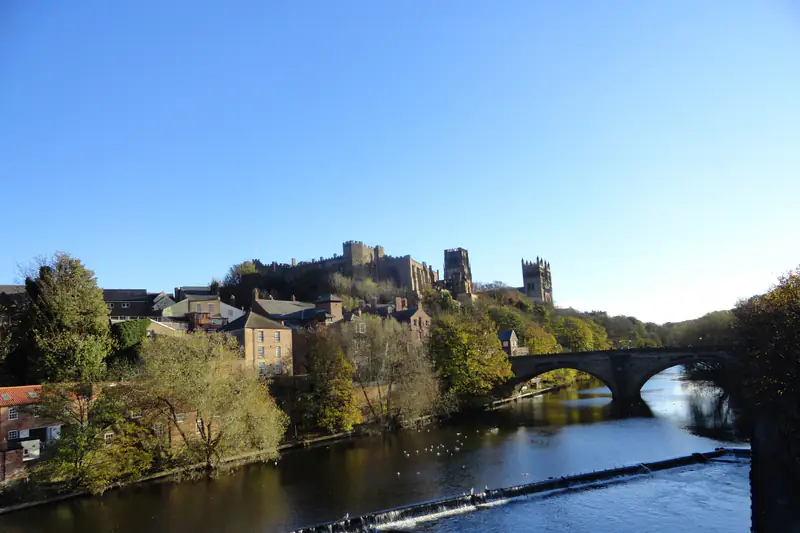
Each setting raises a different first question: in the historic core, whether the panels will be seen; on a student let, who pays the electricity bill; on a 1930s semi, roof direction and shading. The service behind the answer stays the same: a survey, a system designed around the property, an itemised quotation, installation, commissioning and handover documents.
Solar Services Available Across Durham
- Domestic solar panels for owner-occupied houses, from city terraces to suburban and village homes.
- Commercial solar PV for offices, workshops, shops and other premises with daytime electricity demand.
- Battery storage, fitted alongside new panels or added to an existing system.
- Maintenance and repairs for existing arrays, including systems fitted by other installers, subject to inspection.
Solar Panels Near the Cathedral: Heritage and Planning in the City
Durham Cathedral and Castle form a UNESCO World Heritage Site, and much of the centre lies within the City of Durham conservation area. Solar is not ruled out here, but the council judges it with more care. Durham County Council is the planning authority, and heritage impact is routinely considered when PV is proposed in the city. The council has guidance on renewables and the historic environment and has consulted on draft solar-specific guidance, so we check the position for your address before finalising any design.
What permitted development allows
Under the national rules for England, updated on 27 August 2026, panels on a pitched roof are generally permitted development if they sit no higher than the highest part of the roof (excluding the chimney) and project no more than 200 mm from the slope. In a conservation area or World Heritage Site, panels must not go on a wall that fronts a highway, and flat-roof installations need prior approval from the council. A rear slope that cannot be seen from the street is often the simplest option.
Listed buildings
Listed buildings have no permitted development rights for solar, and the same applies within their curtilage, so listed building consent comes first. If your home is listed, we look at less visible positions at design stage, such as a concealed valley roof or an outbuilding, before an application is prepared.
Can Landlords Fit Solar Panels to Student HMOs?
They can, and Durham has a large stock of shared student houses, particularly around the Viaduct, Gilesgate and Claypath. Where rent includes bills, the landlord carries the electricity cost, so the daytime load from fridges, laundry, lighting and laptops in a shared house can absorb a good share of what the panels produce. Many of these properties are tall Victorian terraces with narrow roof slopes and limited rear access, which affects scaffolding and how many panels will fit.
Equipment placement matters more in an HMO than in a family home. PAS 63100, the British Standards specification for home battery fire safety, prefers outdoor locations or outbuildings and advises against lofts and escape routes, so the inverter and any battery are sited with that in mind. Many student lets change over in the summer, when an empty house makes access easier. If you manage several properties, one survey visit can cover a group of addresses with a separate quotation for each.
Installing solar panels and battery storage in homes in Great Britain is currently zero-rated for VAT: 0% until 31 March 2027, then 5% unless the relief is extended (HMRC VAT Notice 708/6).
Suburbs and Former Colliery Villages
Newton Hall, Framwellgate Moor and Belmont are largely made up of 1930s and post-war houses, typically with simple pitched roofs and room for a mid-sized array. A home solar panel system of around 4 to 4.5 kWp normally needs nine or ten modern panels, which many semi-detached roofs can take on a single slope. East- and west-facing roofs still generate a useful amount, spreading output across the morning and late afternoon rather than peaking at midday.
In the former mining villages around the city, long terraced streets are common, as they are in many of the towns we cover across the North East. An unbroken terrace roof can work well, although chimneys and rear offshoots eat into the usable area. We also check older slate or tile coverings at survey. If a roof is likely to need work in the next few years, doing it before the panels go on usually costs less than removing and refitting them later.
Commercial Solar PV for Durham Businesses
Offices, workshops and retail units often use most of their electricity in daylight, when panels produce it. North East Solar Installer sizes commercial systems from half-hourly consumption data where available, so the array matches what the building uses rather than filling the roof. With County Durham working towards net zero by 2045, on-site generation is a practical step for an organisation that has suitable roof space.
Non-domestic roofs follow separate rules. Roof-mounted PV on commercial buildings currently needs prior approval from the council, including a glare assessment, with a 56-day decision period. Larger systems will usually also need a G99 application to Northern Powergrid before connection, and the project timeline allows for both.
Adding a Battery or Repairing an Existing System
If you already have panels, a retrofit battery can hold back daytime surplus for the evening. The check starts with your existing inverter and supply, because storage adds to the total generation capacity at the property. Once the combined figure goes above 16 A per phase (about 3.68 kW on a single-phase supply), the project moves from a simple G98 notification to a G99 application to Northern Powergrid.
For underperforming arrays, the repair service covers inverter faults, damaged cabling and loose fixings on systems from any installer, once inspected.
What Affects the Cost of Solar in Durham?
The Energy Saving Trust estimates that a typical 4.5 kWp home system costs about £7,600 (figure quoted in September 2026). Durham properties can move away from that figure because of scaffolding on steep or narrow city streets, extra design work in a heritage setting or roof repairs found during the survey. A battery adds a further cost that depends on its capacity. Every quotation is itemised, and the solar panel costs guide explains the main price factors in more detail.
Planning Solar for a Durham Property?
Send your postcode, the property type and a recent electricity bill, and say whether the building is listed, in the conservation area or let to students. North East Solar Installer will set out what the survey needs to check.
Areas Covered In and Around Durham
Surveys cover the city centre, Gilesgate, Claypath, Belmont, Neville’s Cross, Framwellgate Moor, Newton Hall, Langley Moor and the surrounding villages. Nearby towns have their own pages, including solar panels in Washington, Sunderland and Gateshead. For an address further out in the county, include the postcode when you contact us and coverage will be confirmed in the reply.