
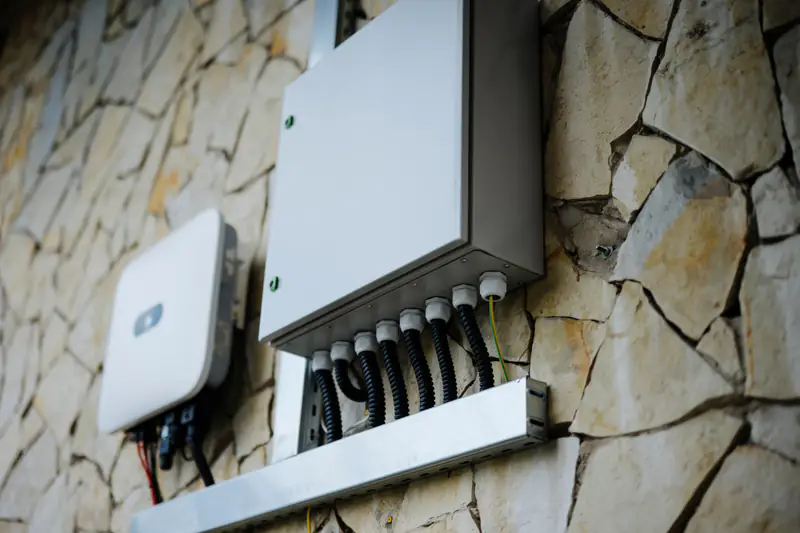
A battery will not increase what your panels generate, but it lets you use more of that electricity later in the day. Without storage, most homes export a large share of their midday output and then buy power back in the evening, when demand peaks. A correctly sized battery closes some of that gap.
Battery Storage for New and Existing Solar Systems
With a new solar installation
Planning panels and storage together is the simplest route. A single hybrid inverter can run both, the network paperwork is handled once and the work is completed in one visit. Find out more about domestic solar panel installation or, for business premises, commercial solar PV.
Adding a battery to existing solar panels
Most existing systems can take a battery. The deciding factor is usually your current inverter: its make, model, age and warranty status determine whether a battery should sit alongside it or whether replacing it with a hybrid unit makes more sense. If your system receives Feed-in Tariff payments, we connect the battery so the generation meter keeps recording as it should.
AC-Coupled or DC-Coupled?
There are two ways to connect a battery, and the right one depends on what is already on your wall.
AC coupling
The battery has its own inverter and connects on the AC side of your electrics, independently of the solar inverter. Your existing panels and inverter are left untouched, which makes this the usual choice for retrofits where the solar inverter still has plenty of life in it. Power is converted a few more times on its way in and out, so a little more energy is lost along the way.
DC coupling
Panels and battery share one hybrid inverter, and solar charges the battery directly without extra conversion. This suits new installations, and retrofits where the old inverter is ageing or out of warranty and due for replacement anyway.
How Much Battery Capacity Do You Need?
Sizing balances three figures: how much surplus your panels export on a typical day, how much you use between early evening and morning, and the tariff you are on. Two specifications matter on any battery datasheet. Usable capacity, in kWh, is how much energy it can deliver. Power rating, in kW, is how quickly it can charge or discharge, which decides whether it can keep up with an electric oven or a heat pump.
In the North East, roughly 30% of annual solar output arrives between September and February, so a battery sized purely on summer surplus can sit half-empty through winter unless it also charges off-peak. Tell us about planned changes, such as an electric car or heat pump, so we can factor them in from the start.
Getting More from Time-of-Use Tariffs
Time-of-use and overnight tariffs charge less during set off-peak hours. A battery can fill up in those hours and then supply the house through the expensive evening peak, which is especially useful in the darker months. Charging schedules are set up at commissioning and can be changed if you switch tariff. Any saving depends on the gap between peak and off-peak rates, the battery's efficiency and how you use electricity, so we state the assumptions in your quotation rather than promising a figure.
Battery storage installed in homes in Great Britain, including standalone batteries and batteries retrofitted to existing solar, currently qualifies for the zero rate of VAT on energy-saving materials. The rate is 0% until 31 March 2027 (then 5% unless the relief is extended).
Will a Battery Keep the Power On in a Power Cut?
Not automatically. When the grid fails, a standard grid-connected solar and battery system shuts down so it cannot feed power onto cables that network engineers may be working on. Backup needs extra equipment, which our installers can fit, such as an inverter with an emergency power output or a backup gateway that safely separates the property from the grid.
Even with backup fitted, it normally covers selected circuits, such as lighting, the fridge and the broadband router, for as long as the stored charge lasts. If backup matters to you, tell North East Solar Installer which circuits you want covered and we will design around them.
Where Can the Battery Go?
PAS 63100:2024, published by BSI in March 2024, is the specification for fire protection of battery storage in homes. It is not law, but we plan battery positions in line with its guidance:
- The preferred locations are outdoors or in a garage or outbuilding.
- Lofts and roof voids, escape routes and rooms opening onto sleeping areas are avoided unless specific conditions are met.
- Interlinked smoke or fire detection is needed where the battery is located.
The specification applies to dwellings up to 200 m². Manufacturer limits on temperature, ventilation and clearances also apply, which matters in an unheated garage through a North East winter.
Northern Powergrid Approval: G98 or G99
For network purposes, a battery counts as generation. The G98 route covers type-tested equipment up to 16 A per phase, about 3.68 kW on a single-phase home supply, and allows connection first with notification to Northern Powergrid within 28 days. The limit applies to everything at the property combined, so adding a battery to an existing solar system can tip it into G99. That route needs an application and approval before connection, although fast-track routes exist for simple cases. North East Solar Installer handles whichever applies as part of the installation.
How a Battery Installation Runs
- You send your details and, for a retrofit, photos of your inverter and its label.
- A survey checks the inverter, consumer unit, supply and the safest battery position.
- The quotation sets out usable capacity, coupling method, location, backup option and network route.
- The G98 notification or G99 application is made.
- The battery is installed, commissioned and set up for your tariff, and monitoring is explained at handover.
Request a Battery Storage Quote
Tell North East Solar Installer whether you already have panels, the make and model of your inverter, your current tariff and roughly when you use most electricity. Mention whether backup is important. If your existing system has a fault or an inverter error, it can be diagnosed first through the solar panel repairs service. Battery installations are available in Sunderland, North Shields, Cramlington and the other areas we serve. Read about solar and battery costs, then send your enquiry.