
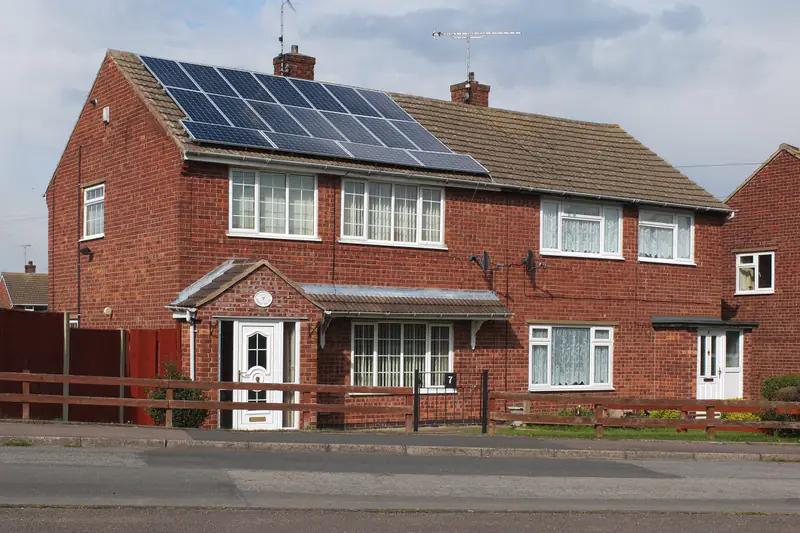
Home solar works best when the design starts with the house rather than a standard kit, so that as much of the generation as possible is used indoors. For shops, offices and industrial units, see commercial solar panel installation.
What a Home Solar Installation Includes
You deal with one installer from first enquiry to switch-on:
- A property survey of the roof, shading, access and your consumer unit.
- A system design with the panel layout, inverter choice and estimated annual generation.
- An itemised quotation with scaffolding, electrical work and any battery listed as separate lines.
- Installation and commissioning of the panels, inverter, isolators and generation meter.
- Network paperwork for Northern Powergrid, the electricity network operator for the whole North East.
- Handover documents, test results and a walk-through of your monitoring.
Is Your Roof Suitable for Solar Panels?
Most pitched roofs in the region can take panels, and many flat roofs can too. Our surveyor checks four points in particular.
Orientation and pitch
A south-facing roof gives the highest yearly output, but east and west-facing slopes still generate well and spread output across the morning or evening. As a guide, an unshaded south-facing array in the UK produces roughly 900 kWh per kWp each year, with the North East sitting in the lower-middle of the national range.
Shading from chimneys, dormers and trees
Chimney stacks, dormers, extensions and mature trees can shade part of an array. Placing the panels around the shade deals with most of this, and optimisers can stop one shaded corner pulling down the output of a whole string.
Roof condition and loading
Panels stay in place for decades, so slipped slates or tired flashings are best repaired first. Building regulations also require the roof's ability to carry the extra load to be checked.
Tyneside flats, leasehold flats and shared roofs
Upstairs and downstairs Tyneside flats, common in Heaton, Byker and Bensham, share a single pitched roof, and who owns or controls it depends on the title deeds. Leasehold flats usually need the freeholder's consent. Check your deeds or lease before you enquire, and our surveyor can confirm whether a system can serve one flat alone or whether the neighbouring owner needs to be involved.
Planning Permission, Listed Buildings and Conservation Areas
For most houses in England, rooftop solar is permitted development, so no planning application is needed. Planning Portal guidance, reflecting changes that took effect on 27 August 2026, sets out the main conditions for houses:
- On a pitched roof, panels must not sit above the highest part of the roof (excluding the chimney) and must project no more than 200 mm from the roof slope.
- On a flat roof, equipment must stand no more than 600 mm above the highest part of the roof. In conservation areas and other protected land, flat-roof installations need prior approval.
- In conservation areas, panels must not be fitted to a wall that fronts a highway.
Listed buildings fall outside permitted development, as do installations within the curtilage of a listed building, so listed building consent is required. Period homes in Jesmond, Tynemouth or the historic centre of Durham are checked at design stage, before you commit to anything.
How Many Solar Panels Does Your Home Need?
Sizing starts with your annual electricity use, shown on your bills or your supplier's app. An average UK household uses around 3,400 kWh a year, and a four-bedroom home closer to 4,000 kWh. Typical residential panels are now rated at 430 to 460 W and each take up roughly 2 m² of roof, so a 4 to 4.5 kWp system usually means nine or ten panels.
Daytime habits matter as much as the annual total, because power used as it is generated is worth the most. Mention plans for an electric car or heat pump early, so North East Solar Installer can leave room for them in the design. Roughly 70% of a year's output arrives between March and August, so judge any design on its output across the whole year rather than a bright week in June.
Adding a Battery to Home Solar
A battery stores surplus daytime generation for the evening and can also charge on a cheaper overnight tariff. Fitting one with new panels means a single hybrid inverter and one installation, at an extra cost that depends on capacity. Backup during a power cut has to be designed in rather than assumed. See solar battery storage for sizing and adding a battery later, or browse our solar services for everything else we install and maintain.
From Enquiry to Switch-On
- 1
Enquiry and first check
Send your postcode, property type and a recent electricity bill. North East Solar Installer reviews whether the property is likely to suit solar before a survey is booked.
- 2
Survey and design
The roof, loft, consumer unit and inverter position are assessed, and a panel layout with a generation estimate is prepared.
- 3
Itemised quotation
You receive a written quote breaking down panels, inverter, scaffolding, electrical work and any battery, with planning notes for your property.
- 4
Northern Powergrid notification
Systems within the G98 limit of 16 A per phase, about 3.68 kW on a single-phase home supply, are connected and then notified within 28 days. Larger systems, or solar and a battery that together exceed the limit, need G99 approval before connection, with a typical target of 45 working days for a low-voltage offer.
- 5
Installation
Scaffolding goes up, rails and panels are fixed, and the inverter, isolators and generation meter are fitted. Most homes take one to two days on site.
- 6
Commissioning and handover
The system is tested and commissioned, monitoring is set up and the handover pack is explained. If a fault appears in later years, we can help through our solar panel maintenance and repairs service.
What Affects the Price of Home Solar?
Your quote depends on your roof, your access and the equipment you choose. The main factors are:
- System size and the specification of the panels and inverter.
- Scaffolding and access, for example on three-storey terraces, over conservatories or from a narrow back lane.
- Electrical upgrades, such as a replacement consumer unit.
- Battery capacity, if storage is included.
As a benchmark, Energy Saving Trust estimates (September 2026) put a typical 4.5 kWp home system at about £7,600. Solar panels installed on homes currently carry 0% VAT until 31 March 2027 (then 5% unless the relief is extended). Smart Export Guarantee payments vary by supplier and need a suitable smart meter. The solar panel costs guide explains how to compare quotations.
Request a Home Solar Quote
Tell North East Solar Installer your postcode, property type, roof direction if you know it and your approximate annual electricity use. Mention planned roof repairs, listed status and any interest in a battery. Installations are available in Newcastle, Gateshead, Whitley Bay and the other areas we serve. Send your enquiry and the next step is a survey of your home.